
The Short Version
Solar Feed-in Tariffs in NSW at a Glance
A solar feed-in tariff in NSW is the credit your retailer pays for solar you send to the grid. Here’s what matters most.
- Each retailer sets its own feed-in tariff.
- There’s no minimum in NSW. For 2026–27, IPART’s all-day benchmark is 3.4 to 6.5c per kWh.
- Exported solar is worth most from about 4pm to 9pm, and least at midday.
- Using or storing your own solar usually saves more than exporting it.
The Basics
What Is a Solar Feed-in Tariff?
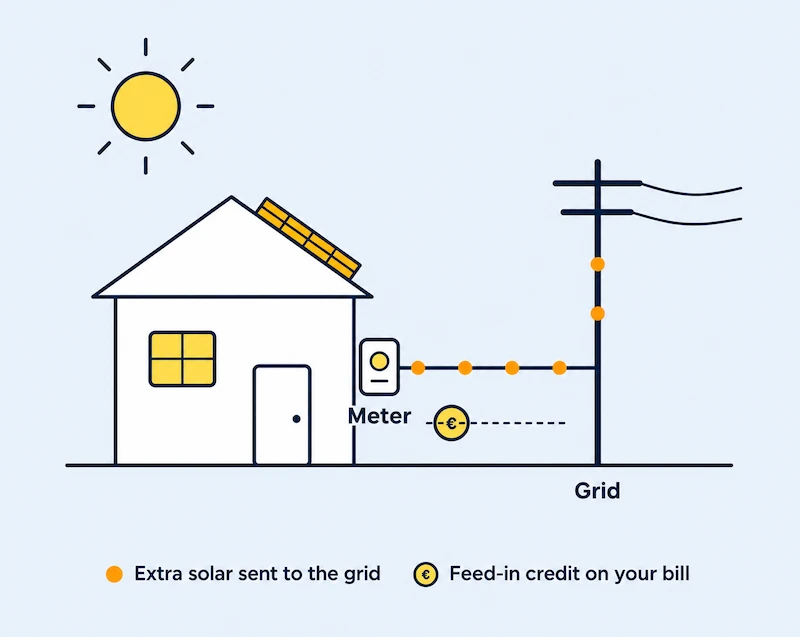
The credit you receive for the extra solar your home sends to the grid.
When your solar panels make more electricity than your home is using, the extra flows out through your meter to the grid. Your electricity retailer credits you for each kilowatt-hour (kWh) you export. That credit is your feed-in tariff, shown on your bill in cents per kWh.
In NSW, feed-in tariffs are set by retailers, not the government. That’s why rates and conditions differ from plan to plan, and why it pays to compare the whole plan, not just the feed-in rate.
2026–27 Benchmarks
What Are Feed-in Tariffs Worth in NSW?
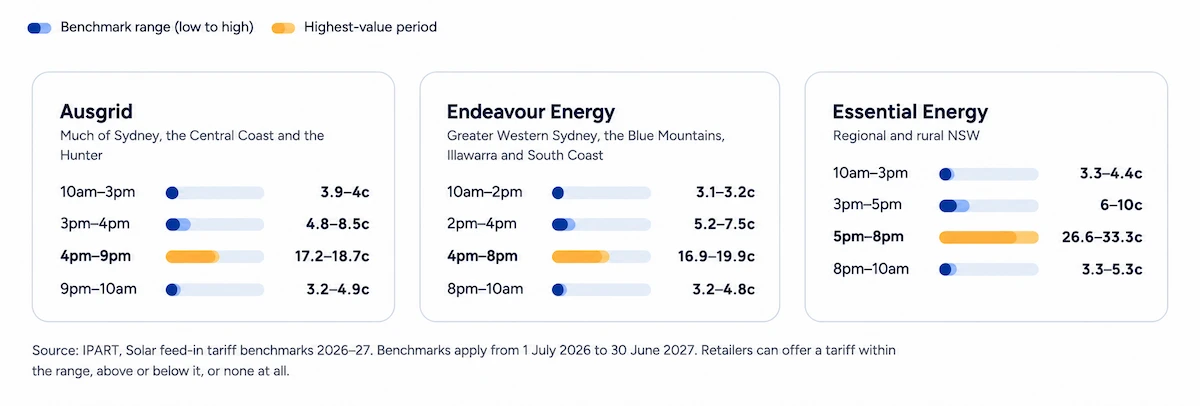
Each year, the NSW pricing regulator IPART publishes benchmark ranges as a guide to what exported solar is worth. Retailers don’t have to pay them.

Time-of-day benchmarks by network (c/kWh)
Some retailers pay different rates at different times of day. Your network is shown on your electricity bill.
Use It or Export It
Why Using Your Solar Usually Beats Exporting It
Retail electricity prices are much higher than feed-in tariffs, so each kWh you use yourself is usually worth more than one you export.

Simple ways to use more of your own solar
- Run the dishwasher, washing machine and dryer during the day.
- Set pool pumps and electric hot water to run on solar hours.
- Charge an electric vehicle in the middle of the day when you can.
- Add a home battery to store midday solar for the evening.
What’s Changing
Two-Way Pricing and the Solar Sharer Offer
Two newer changes affect how solar exports and daytime power are priced in NSW.
Ausgrid network
Two-way solar pricing
Since July 2025, Ausgrid has applied two-way pricing to export-ready residential and small business customers.
- The first 200 kWh exported between 10am and 3pm each month is free.
- Above that, a small network charge can apply.
- Exports between 4pm and 9pm can earn a network reward.
Retailers decide how they pass these prices on, so check your plan.
From 1 July 2026
The Solar Sharer Offer
Since July 2025, Ausgrid has applied two-way pricing to export-ready residential and small business customers.
Larger retailers in NSW must offer eligible households a plan with three hours of free electricity in the middle of the day.
- Up to 24 kWh of free electricity a day in the free window.
- You need a smart meter. You don’t need solar panels.
- Supply charges and power used outside the window are still billed.
It’s optional. Compare it with your current plan before switching.
Next Steps
How to Get More From Your Solar in NSW
- Check your bill – Find your feed-in rate, your network and whether you have a smart meter.
- Compare plans – Use Energy Made Easy to compare whole plans, not just feed-in rates.
- Shift your usage – Run high-use appliances while your panels are producing.
- Consider a battery – Store midday solar to use in the evening, when grid power costs more. See battery options.
Feed-in Tariff FAQs
Common questions from Sydney homeowners about solar feed-in tariffs.
Thinking about solar or a battery? Read about residential solar in Sydney or battery storage solutions.
What is the solar feed-in tariff in NSW?
It’s the rate your electricity retailer credits you for each kilowatt-hour (kWh) of solar you export to the grid. In NSW, each retailer sets its own rate. For 2026–27, IPART’s all-day benchmark is 3.4 to 6.5 cents per kWh.
Do NSW retailers have to pay a minimum feed-in tariff?
No. There is no mandatory minimum feed-in tariff in NSW. IPART’s benchmarks are a guide to what exported solar is worth, and retailers can offer more, less or nothing at all.
When is exported solar worth the most?
Late afternoon and evening. IPART’s 2026–27 time-of-day benchmarks are highest from about 4pm to 9pm (exact times depend on your network), and lowest in the middle of the day when most solar is exported.
Is it better to use my solar or export it?
Usually it’s better to use it. Each kWh of solar you use yourself saves you buying that kWh from the grid at the full retail price, which is much higher than the feed-in tariff. A battery lets you store midday solar for the evening.
Can I still get a feed-in tariff if I have a battery?
Yes. Solar that isn’t used in your home or stored in your battery is still exported and credited at your plan’s feed-in tariff.
How do I know which electricity network I’m on?
Your network is shown on your electricity bill. Most Sydney homes are on Ausgrid or Endeavour Energy.
Sources
- IPART: All-day solar feed-in tariff benchmark 2026–27
- IPART: Time-of-day solar feed-in tariff benchmarks 2026–27
- Ausgrid: Two-way solar pricing
- energy.gov.au: Solar Sharer Offer
Information current as at November 2026. This guide is general information only. Check your retailer’s plan for the rates that apply to you.