
The Short Version
System Size at a Glance
The right size depends on how much power you use, when you use it, and what your roof and network allow. Here’s what matters most.
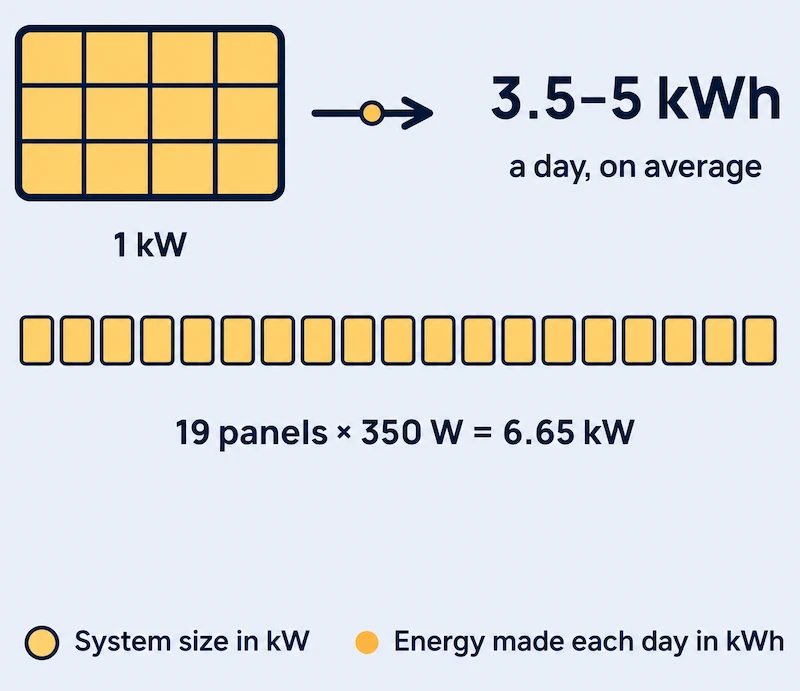
- Each 1 kW of panels makes about 3.5 to 5 kWh a day, averaged across the year in Australia.
- A typical 4-person home in greater Sydney uses about 20 kWh a day, on the AER’s benchmark.
- Solar is worth most when you use it as it’s made, so when you use power matters as much as how much.
- Your roof’s direction, angle and shade, and your network’s export limits, set the practical ceiling.
The Basics
What Does System Size Mean?
The total rating of your panels in kilowatts (kW). It tells you their peak output, not what they make each day.
Each panel has a rating in watts (W), measured in standard test conditions. Add the panels together and you get the system size. For example, 19 panels at 350 W make a 6.65 kW system.
What the system actually makes is measured in kilowatt-hours (kWh). Across Australia, each 1 kW of panels makes about 3.5 to 5 kWh a day averaged over the year: more in summer, less in winter. Home panels are about 1 m × 1.7 m, so roof space also limits how many fit.
Sydney Benchmarks
How Much Power Does a Sydney Home Use?
The Australian Energy Regulator publishes typical usage for homes of each size. It’s the same comparison printed on your power bill.
Sydney homes use the most power in winter, when solar makes the least. Your bill shows your own daily average.

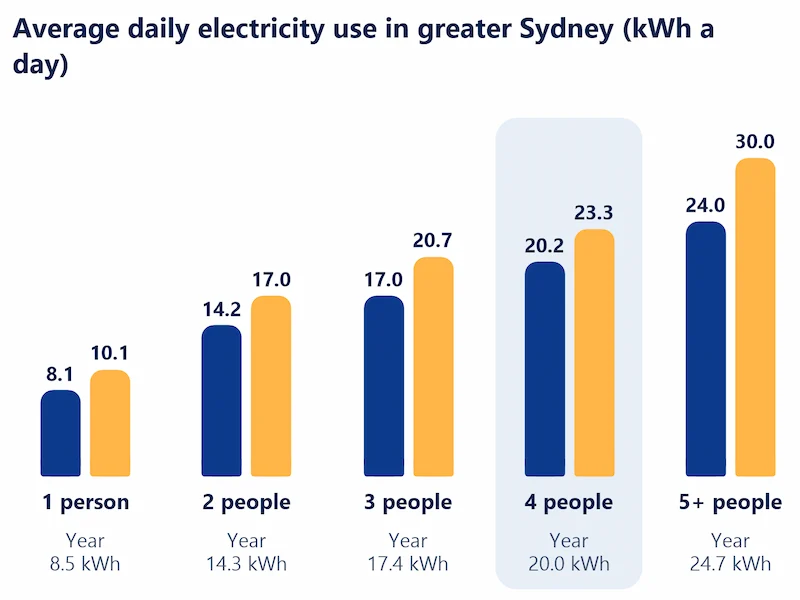
Source: Australian Energy Regulator, Residential energy consumption benchmarks (December 2020), Climate Zone 5, which covers greater Sydney. Daily figures are the AER’s seasonal totals divided by the days in each season. The benchmarks don’t model pools or controlled-load hot water.
Use It as It’s Made
Why Daytime Use Matters as Much as Total Use
Solar is worth most when you use it as it’s made. Feed-in tariffs are usually much lower than what you pay for grid power.

Simple ways to move your use into solar hours
- Run the washing machine and dishwasher on a timer during the day.
- Switch to heat pump hot water and run it in the middle of the day.
- Check your smart meter data to see when you use the most power.
- Plan for an electric car or a home battery before you choose a size.
Before You Choose
Your Roof and Your Network’s Limits
Two practical limits shape the final size: what your roof can make, and what your network lets you export.
Your roof
Direction, angle and shade
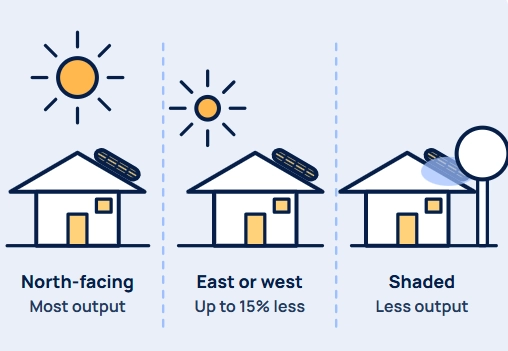
North-facing, unshaded roofs make the most. Other directions still work well.
- East- or west-facing panels on a 20° roof can make up to 15% less a day than north-facing ones.
- Panels should tilt at least 10° so rain can wash them clean.
- Shade on one panel can pull down the output of the panels wired with it.
Ask for an estimate based on your roof, not a generic figure.
Ausgrid network
Approval and export limits
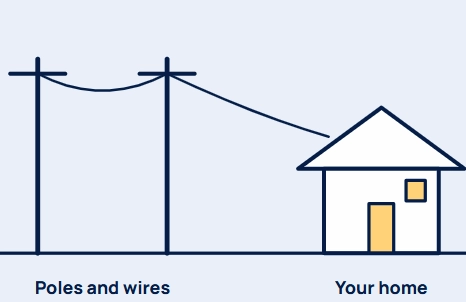
Your network must approve your system, and it can limit how much you send to the grid.
- Up to 10 kW of inverter capacity per phase can go through Ausgrid’s streamlined approval.
- On a flexible connection, single-phase homes can export up to 10 kW, and three-phase homes up to 30 kW.
- On a fixed connection, exports are limited to 3 kW per system.
Other networks set their own rules. Your installer usually applies for approval for you.
Next Steps
How to Work Out Your System Size
- Check your bill – Find your average daily use in kWh. Compare a summer bill with a winter one.
- See when you use power – Smart meter data shows your use every half hour, so you can see how much falls in solar hours./li>
- Plan ahead – Allow for an electric car, a home battery or switching your gas appliances to electric.
- Have your roof, shade and switchboard checked before you settle on a size. Request a consultation.
System Size FAQs
Common questions from Sydney homeowners about sizing a solar system.
Ready to look at options? Read about residential solar in Sydney or battery storage solutions.
What size solar system do I need for my home?
It depends on how much power you use, when you use it, your roof and your network’s export limits. As a guide, a typical 4-person home in greater Sydney uses about 20 kWh a day on the AER benchmark. Your own bill is the best starting point.
How much power does a 6.6 kW system make?
Roughly 23 to 33 kWh a day averaged over the year, based on 3.5 to 5 kWh for each 1 kW of panels. It makes more in summer and less in winter, and your roof’s direction and shade change the result.
How many panels make a 6.6 kW system?
It depends on the panel rating. For example, 19 panels at 350 W make 6.65 kW. Higher-rated panels mean fewer panels for the same system size.
Can I put a 10 kW system on single-phase power in Sydney?
On the Ausgrid network, up to 10 kW of inverter capacity per phase can go through streamlined approval, and how much you can export depends on your connection type. Panels can be sized up to about a third larger than the inverter. Other networks set their own rules.
Does my roof need to face north?
No. North-facing, unshaded roofs make the most, but east- and west-facing panels still work. On a 20° roof they can make up to 15% less a day, with more of their output in the morning or late afternoon.
Should I size my system for a future battery or EV?
It’s worth planning for. An electric car or an all-electric home will raise your power use. A battery only pays off if you have spare solar to store, so compare its cost with the savings first.
Sources
- AER: Residential energy consumption benchmarks (December 2020)
- energy.gov.au: Solar panels
- energy.gov.au: How solar pays for itself and batteries reduce bills
- Solar Victoria: Planning your solar electricity system
- Ausgrid: Choosing a solar system
- NSW Government: Guide to solar panels
Information current as at November 2026. This guide is general information only. Your installer will confirm the right size for your home, roof and network.